What we will process
Six services. One standard.
TerraKai’s Palghar facility is being built around a single documentation regime, applied uniformly across every service stream. Commissioning Q1 2027. The audit & compliance posture behind the regime is documented in full.
Accepted e-waste maps to WEEE Categories 3 (IT & Telecom Equipment), 4 (Consumer Equipment), and 6 (Electrical & Electronic Tools) under the European framework — and to the equivalent categories of CPCB E-Waste Rules 2022 in India.
01
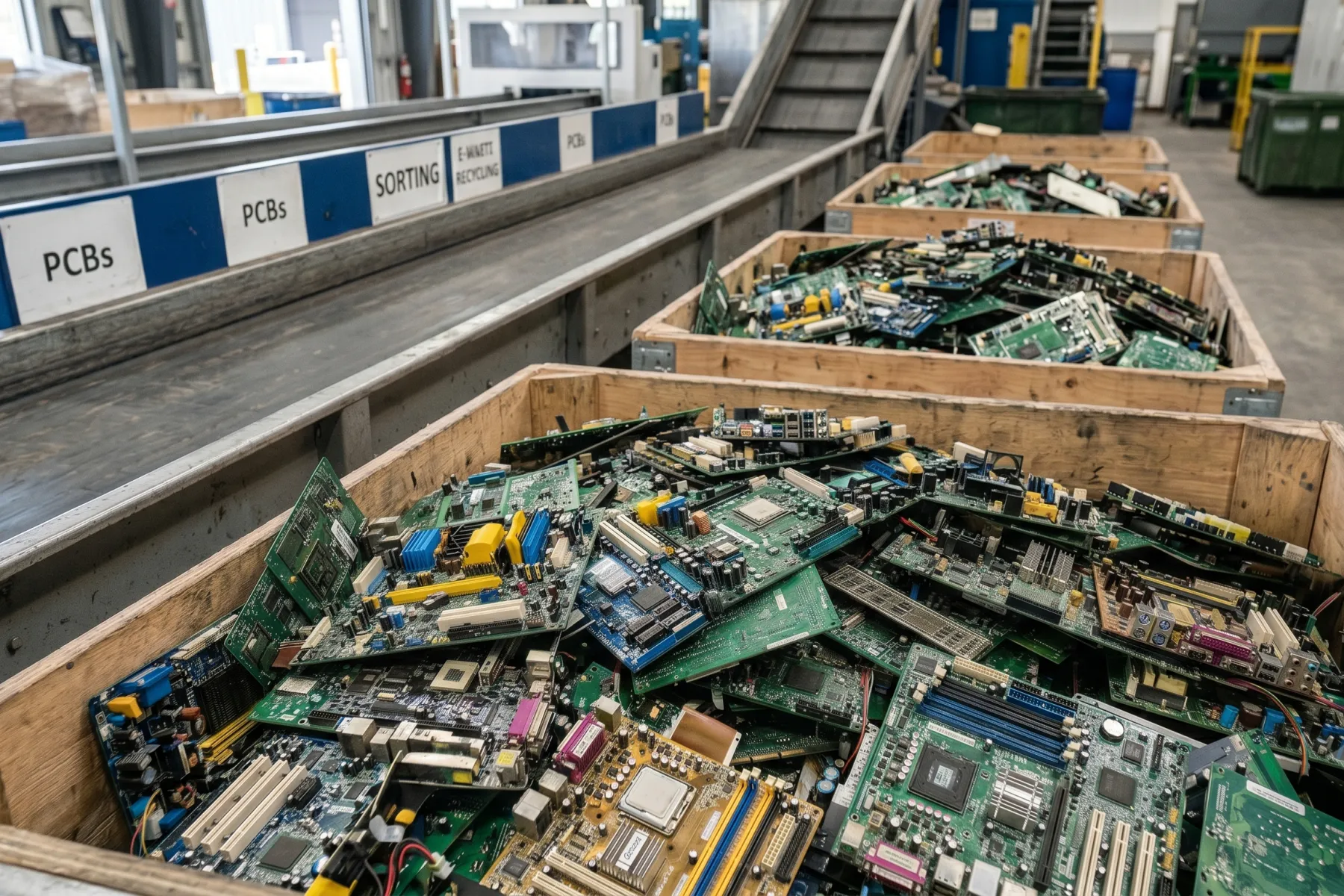
Printed circuit boards.
Direct mechanical recovery of copper from end-of-life PCBs. Precious-metal-bearing concentrate (gold, palladium, silver, tin) routed to verified, named downstream refiners — with chain-of-custody documented from intake through refiner-side recovery. No informal channels, no downstream disappearance.
Every consignment will be weighed at intake, photographed, and tagged with a batch identifier. Yields will be reconciled against intake weight at output. The full chain will be exportable to your audit team in the format your audit team requires.
In-house precious-metal extraction (hydrometallurgy) is on the Phase 2 roadmap; Year 1 operates strictly as mechanical processing with named downstream refining partners.
Accepted
Motherboards · GPU cards · RAM modules · Server boards · RAID controllers · Networking PCBs · Switching cards · Backplane assemblies · SMPS boards · PSUs · Expansion cards · Mobile and tablet boards · IoT controllers · Voltage-regulator boards · HDD/SSD controller boards · BMS (battery management) boards · Inverter and VFD boards

02
Cables and connectors.
Granulation of copper and aluminium cables. Recovery of metal fraction; documented handling of plastic and insulation by-product.
Weighbridge-to-output reconciliation per consignment. Documented disposal pathway for non-metal fraction. No mixed flows. No unaccounted residue.
Accepted
Copper LAN cables · Fibre-optic cables · Coaxial · Twisted-pair · Patch cables · USB cables · HDMI cables · DisplayPort cables · Audio and video cables · Power cables · Armoured cables · Control cables · Harness wiring · Telecom backbone cables · Jelly-filled cables · OFC · Shielded cables · Ribbon cables

03
IT asset disposition.
For procurement teams retiring servers, laptops, switches, storage arrays, and telecom infrastructure.
Serial-level asset tracking from collection to disposition. Certified data destruction with auditable proof of erasure or physical destruction. A disposal certificate per asset, indexed to your asset register. Designed for the CSR head whose board asks where the bank’s decommissioned equipment went and expects an answer the auditors will sign off on.
Accepted
Laptops · Desktops · Workstations · All-in-ones · Mobile devices (work phones, tablets, ruggedized handhelds) · Rack servers · Blade servers · Hyperconverged units · SAN/NAS arrays · Tape libraries · Individual drives · UPS systems · PDUs (power distribution units) · Battery banks · Rack cooling units · KVM switches · Switches · Routers · Firewalls · Load balancers · Wireless access points · PBX systems · IP phones · Conference systems · Interactive displays · Video walls · Presentation systems · CCTV cameras · NVRs and DVRs · Access-control panels · Biometric devices · Monitors · Printers · Scanners · Projectors · Keyboards · Mice

04
Refurbishment.
For IT assets where reuse is possible — laptops, servers, monitors, telecom equipment with operational life remaining.
Per-asset assessment at intake: refurbishment-vs-destruction decision documented and exportable. Refurbished assets routed to verified secondary-use channels with traceable downstream destination. Destroyed assets follow the ITAD chain-of-custody with certificate per asset.
Designed for procurement teams whose CSR commitments value circular reuse over destruction — with the same documentation discipline applied to refurbishment routing as to destruction.
Accepted
Laptops · Workstations · All-in-ones · Rack servers · Blade chassis · Monitors · Signage displays · Enterprise switches · Routers · Wireless equipment · IP phones · Conference systems (each assessed individually for reuse vs destruction)

05
EPR fulfilment.
For brand owners and importers subject to CPCB E-Waste Rules 2022 — IT OEMs, white-goods manufacturers, telecom infrastructure suppliers, and importers requiring audit-defensible EPR compliance.
Authorised EPR certificates issued against verified recycling of equivalent tonnage at the Palghar facility. Designed for procurement and compliance teams whose CSR reporting requires year-on-year EPR-certificate paper trail.
Available post CPCB EPR Authorisation — currently in preparation.
Accepted
IT OEMs · White-goods manufacturers · Importers · Brand owners under CPCB E-Waste Rules 2022
06
On-site decommissioning.
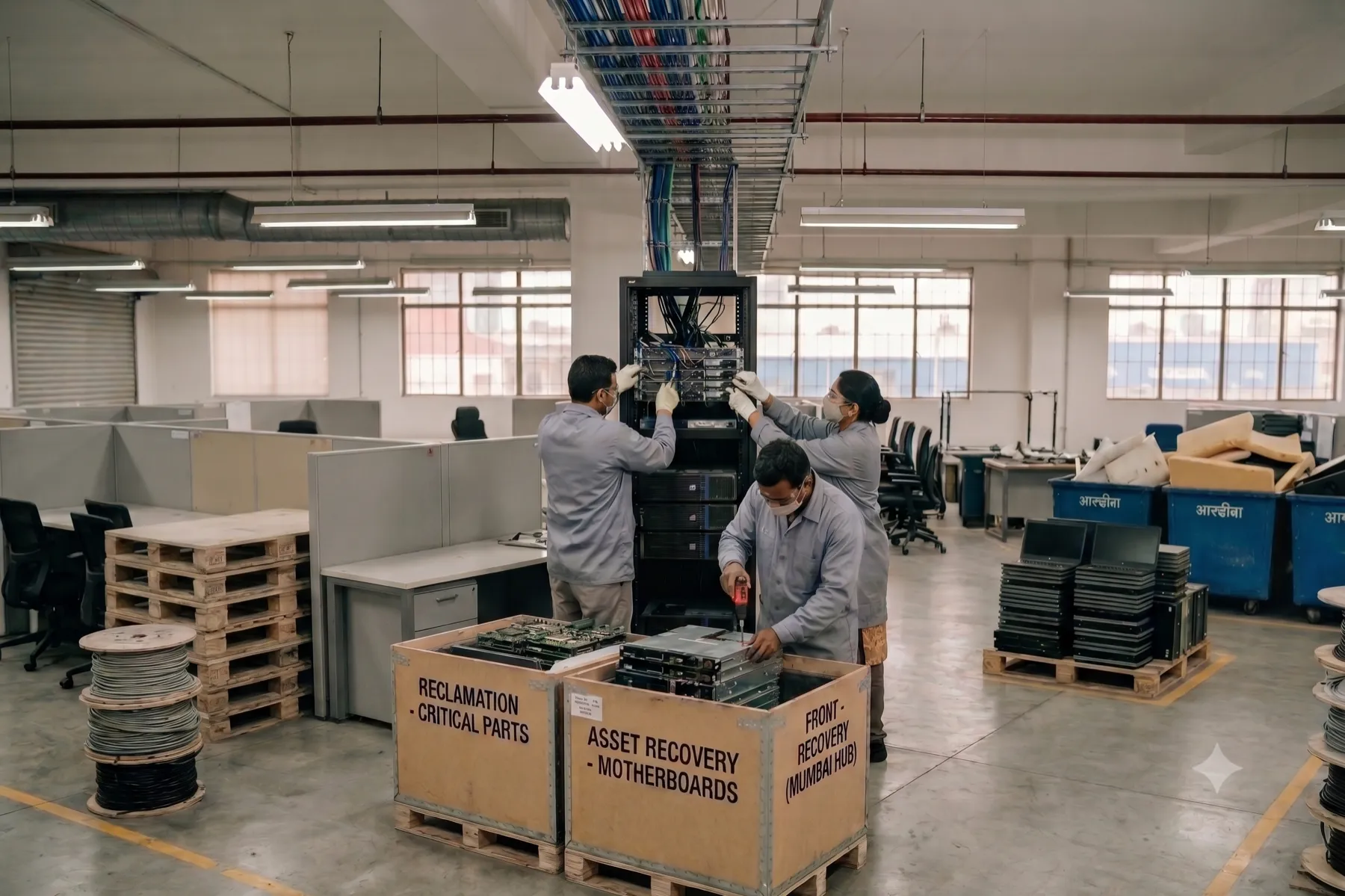
For multi-site IT and infrastructure decommissioning projects — data-centre retirements, office closures and relocations, branch IT consolidation, telecom exchange decommissioning, M&A integration. TerraKai crews arrive at your site and handle the work in place.
Site survey, cable removal, rack-by-rack dismantling, serial-level asset tagging at the point of removal, optional on-site data destruction (degaussing or shredding before equipment leaves your premises), sealed-vehicle transport to Palghar, and site handover documentation. Chain-of-custody starts at your floor, not at our gate.
Built on seven decades of Salasar Balaji Group dismantling expertise — from VLCC ship recycling under HKC discipline to the KTPS 720 MW thermal power-plant decommissioning, translated for IT and corporate-infrastructure settings.
Accepted
Data centres · Corporate offices (relocation, closure, refresh) · Bank branches · Telecom exchange sites · Government and PSU facilities · M&A integration projects
On the roadmap
TerraKai’s launch focus is narrow because the discipline is hard. We will expand a category only when we can extend the same documentation regime to it without dilution.
Designed for
Five sectors. One discipline.
-
IT and ITES
Data-centre decommissioning, PCB recovery, ITAD with EPR-compliant disposition
-
Banking and BFSI
Documented asset disposition meeting board CSR requirements and RBI compliance posture
-
Telecom
Network-equipment retirement at scale, cable harvesting, EPR fulfilment for OEMs and operators
-
Government and PSU
Large institutional equipment retirement programmes with documented chain-of-custody
-
Manufacturing
Electronic-waste streams from production-line obsolescence, scrap PCBs, cable offcuts
Beyond the Palghar plant
Salasar Balaji Group capabilities.
Beyond TerraKai’s e-waste processing, the Salasar Balaji Group brings seven decades of industrial dismantling, decommissioning, and recycling capability. For multi-service engagements that bundle on-site dismantling, heavy demolition, or large-scale scrap operations alongside TerraKai’s documented processing, the Group’s adjacent capabilities are available through the same relationship.
-
Industrial demolition
Power plants, refineries, large structural decommissioning. KTPS Kothagudam (720 MW) — the largest thermal power-plant demolition ever undertaken in India.
-
Ship recycling
VLCCs, bulk carriers, tankers under Hong Kong Convention discipline, audited by ClassNK and RINA. Alang yard, 1983 to present.
-
International dismantling
Specialist labour mobilization, complex hazardous-material handling. Kuwait (2010) — military equipment dismantling with recovered scrap returned to India.
-
Scrap import and trading
Multi-decade large-volume scrap-import operations across multiple ship classes and demolition sources. Full-shipload break-bulk operations.
-
Cable recycling
Copper and aluminium cable granulation facility in Maharashtra (2024–present). E-waste-adjacent capability extending into TerraKai’s service line.
Group capabilities above are delivered by Salasar Balaji Ship Breakers Pvt Ltd and other Group entities under separate engagement. Talk to us about bundling these with TerraKai’s processing services.
Questions we hear
Frequently asked.
Is TerraKai EPR-authorised?
Not yet. CPCB EPR Authorisation is in process; the facility commissions Q1 2027. Brand owners under the E-Waste Rules 2022 can engage now on the documentation framework — scope, recovery targets, certificate format, downstream chain — but signed EPR fulfilment work begins only after CPCB Authorisation is on file. We will not pre-claim it.
What’s the chain-of-custody for PCB recovery?
Sealed lot at your floor, weighed and photographed at intake, lot-tagged through mechanical processing, downstream consignment notes for every fraction. Each consignment generates a disposal certificate naming the lot ID, weight by category, processing date, and downstream destination. Audit-defensible by design — that is what the documentation framework is for.
What’s the disposal certificate format for ITAD?
Per-asset where reuse is in scope; per-lot where destruction is in scope. Includes asset ID, serial number, intake date, refurbishment-vs-destruction decision, data-destruction method (NIST 800-88 alignment), date of destruction, witness signature, and downstream destination for material residuals. Exportable to your asset register. Format is shared on first engagement.
Which downstream refiners do you use?
Named on engagement, not on the public site — refiner selection is part of what brand owners audit before signing. Selection criteria are stable: licensed precious-metal refiners with verified environmental compliance, India-domiciled where feasible, with documented mass-balance reporting. The list will appear on consignment paperwork before any material moves.
Can TerraKai handle on-site decommissioning for multi-site bank IT?
Yes — the on-site decommissioning service is built for exactly this. Branch IT consolidation, data-centre retirements, M&A integration projects, telecom exchange decommissioning. Crews arrive at your site, work in place, and chain-of-custody starts at your floor, not at our gate. Multi-site campaigns coordinated as a single engagement with one disposal certificate per site.
Which industries does TerraKai serve at launch?
IT OEMs and corporates retiring servers, laptops, networking gear. Banking and BFSI on branch IT, data centres, ATM fleets. Telecom on exchanges and network infrastructure. Government and PSU on procurement-mandated documentation. Brand owners and importers needing audit-defensible EPR fulfilment. Five sectors, one documentation standard.
What waste categories are out of scope at launch?
Lithium-ion battery recycling is roadmap Phase 2, not Year 1. Household white goods (refrigerators, washing machines, air conditioners) are out of scope; TerraKai is built for industrial and corporate IT/EEE streams, not consumer take-back. Medical equipment with radioactive components is out of scope permanently. Specialty handling routes can be referenced on enquiry.
How do I onboard as a brand-owner EPR partner?
Engagement starts on the contact form or a direct email to hello@terrakairecycling.com. First conversation covers scope, your E-Waste Rules 2022 obligations, your target recovery percentages, and the certificate format you need for internal audit and CPCB filing. Signed EPR fulfilment commences after both sides clear documentation review and CPCB Authorisation is on TerraKai’s file.
What’s the typical turnaround time on a consignment?
Lot intake to disposal certificate is sized for audit clarity, not speed alone. Indicative window from intake to per-lot certificate is two to four weeks, depending on stream and downstream destination. Tighter windows are negotiable for time-bound decommissioning projects. Quoted on the consignment, not as a blanket SLA — the discipline is in the documentation, not in the rush.